Why Correct Data Still Leads to Bad Decisions
Dr. Niklas Richter ·
Listen to this article~5 min

Businesses invest heavily in dashboards and AI, yet decisions still go wrong. Henny Speelman explains how accurate data can mislead, why misinterpretation is dangerous, and how to become a trusted data communicator.
Businesses are pouring money into dashboards, AI, and data analysis. Yet decisions often go wrong. In this podcast episode, we sit down with Henny Speelman, a data visualization and storytelling expert. He explains how accurate numbers can still lead you astray.
Misinterpretation is more dangerous than bad data. AI can accelerate mistakes. And context matters more than adding more metrics. Let's dive into what really makes data work for you.
### The Hidden Danger of Misinterpretation
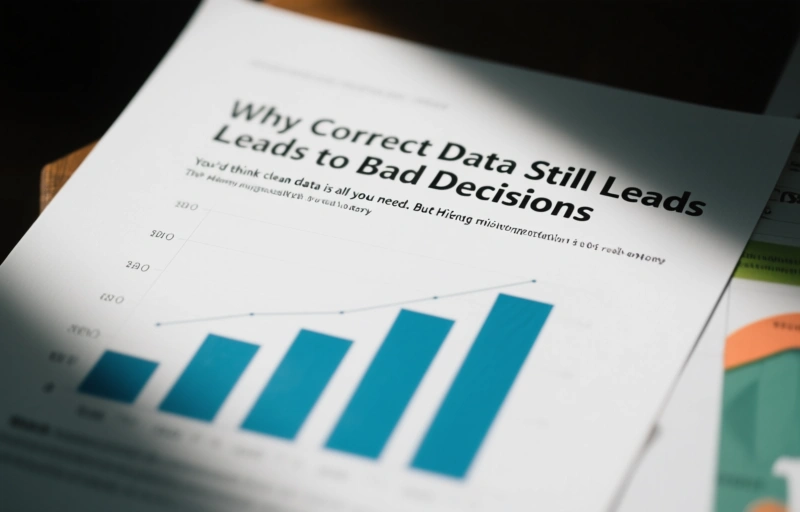
You'd think clean data is all you need. But Henny argues that misinterpretation is the real enemy. A beautiful chart can still tell the wrong story. For example, a line graph showing sales growth might hide a drop in profit margins. Without the right lens, you make choices that look smart but hurt your bottom line.
- Misreading trends leads to costly errors.
- Over-relying on dashboards can create false confidence.
- Context turns numbers into insights.
Think of data like a map. A map can be perfectly accurate, but if you're reading it upside down, you'll still get lost. That's why Henny emphasizes becoming a "trusted data communicator." It's not about more data; it's about better understanding.
### How AI Can Speed Up Bad Choices
AI tools are everywhere. They analyze faster than any human. But here's the catch: if the input is flawed, AI amplifies those flaws. Henny shares a story of a company using AI to optimize pricing. The algorithm worked beautifully—until it didn't. It missed seasonal trends, causing a 15% drop in revenue.
> "AI doesn't know context. It just follows patterns. You have to teach it the right story." — Henny Speelman
To avoid this, you need to audit your data sources. Ask: What assumptions are baked into this model? Is the data current? Are we measuring what matters? A quick check can save you from a costly detour.
### The A.R.T. Model for Clear Communication
Henny introduces the A.R.T. model: Accurate, Relevant, and Timely. It's a simple framework to ensure your data tells a true story.
- **Accurate**: Verify numbers before presenting them. One typo can ruin trust.
- **Relevant**: Focus on metrics that drive decisions. Ignore noise.
- **Timely**: Share data when it's still actionable. Old data is just history.
Imagine you're a restaurant owner. You see that weekend sales are up. But the data is from last month, and you missed a local festival that boosted traffic. Now you're planning based on a ghost. The A.R.T. model helps you avoid these traps.
### From Pretty Charts to Powerful Stories
There's a big difference between a nice visualization and a strong data story. A chart can be colorful and clean but still empty. A story, on the other hand, connects the dots. It answers the "so what?" question.
For instance, a bar chart showing employee hours is just numbers. But a story that says "Our team worked 10% more hours this quarter, leading to a 5% increase in customer satisfaction" gives you something to act on. Henny shows how to bridge that gap.
### Hidden Costs of Poor Data Communication
Bad data communication costs more than you think. Lost time, missed opportunities, and eroded trust add up. Henny estimates that companies lose up to $10,000 per month in productivity due to confusing reports. That's a big number for a small business.
- Teams waste hours interpreting vague charts.
- Decisions get delayed or reversed.
- Employees stop trusting the data altogether.
Investing in clear communication saves money. It builds a culture where everyone speaks the same language.
### Making Data Work for You
At the end of the day, data should bring clarity, build trust, and enable better decisions. Henny's advice: start small. Pick one key metric and tell its story well. Then expand. Avoid the temptation to hoard numbers.
You can download the visual examples from the episode at [this link](https://ondernemerspraat.be/podcast/s6-e19-hoe-correcte-cijfers-toch-tot-verkeerde-keuzes-leiden/). They show exactly how to transform raw data into actionable insights.
This podcast is brought to you by Creatic. We help small and medium businesses build strong digital brands with smart branding, thoughtful marketing, and high-performance websites. From strategy to design, we make your business grow online.
Curious what we can do for you? Visit [www.creatic.be](https://www.creatic.be) to learn more.